


Why is advance care planning important?
We understand that unexpected events happen in life. An advance directive can name someone who can speak on your behalf for medical decisions if you are incapacitated.
Health care decisions with someone you trust
In some states, including Wisconsin, as soon as you turn 18 years old, your family members do not have automatic legal authority to make health care decisions without the court or legal system getting involved. Advance directives are legal documents that provide instructions for medical care and name a health care agent to make decisions on your behalf if you cannot communicate your own wishes.
Make your wishes and values known
Advance care planning involves discussing and preparing for future decisions about your medical care, including completing an advance directive. Your wishes such as tests, use of medicine, what providers or locations you prefer and end-of-life treatment, are just a few health care decisions that may not be known.
By creating an advance care plan, you can make sure that your values, wants and wishes are known without dealing with legal constraints.
How to get started
Complete your advance directive
Download and complete the advance care planning document (also available in Spanish and Hmong). If you have questions, contact your health care provider and team.
Download document for Wisconsin residents
- Advance Directive - WI
- Instrucción anticipada PDF – Wisconsin (Spanish)
- Cov Lus Qhia Ua Ntej PDF – Wisconsin (Hmong)
Download document for Michigan residents
Patient impact
Without advance directives: a life they could not have predicted
Ashley’s step-grandmother suffered a life-altering medical event that not only changed her life completely but continues to greatly impact her whole family. Watch this family’s journey about the importance of having caring conversations about advance directives.
Steps for completing an advance directive
Step 1: Decide you want an advance directive
You are 18 years old, and you live in a state where your family cannot make health care decisions for you legally, such as in Wisconsin. You decide now is the time to start thinking about filing an advance directive.
Step 2: Prepare to answer questions about your medical wants and wishes in writing
You can start to think about your values and wishes when it comes to health care decisions. Questions to ponder are:
- What are my goals and preferences?
- What things are important to me for comfort, such as warm blankets or the most comfortable position in bed?
- If there is time, who should I include in my care decisions?
- If I am near death or cannot communicate, which personal messages do I want my friends and family to receive?
Step 3: Identify a trusted person who can make your health care decisions
A health care agent is a person who makes health care decisions when you can’t make your own choices. Select an agent you trust and who you shared conversations with about your wishes. You also can name alternate health care agents who can make decisions if the person you named first or second cannot or is not willing to make those decisions.
Step 4: Download advance directive
Download an advance directive to complete and contact your health care team with any questions along the way.
Step 5: Find witnesses
In Wisconsin, you must sign your advance directive in the presence of two witnesses who meet the qualifications (details in FAQ section). A notary public cannot be used instead of the two witnesses.
Step 6: Have a conversation
Talk to the rest of your family and close friends who might be involved if you have a serious illness or injury. Make sure they know who your agent(s) is, and what your preferences are.
Step 7: File your advance directive
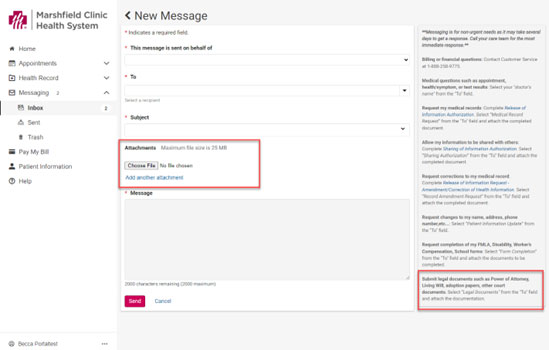
If you have a My Marshfield Clinic account, you can attach your completed document to be routed to Health Information Management (HIM). The documentation must be saved on the device you are using to attach.
Once logged into your account, select Messaging – Inbox – Send a Message.
From there, select your name in the “on behalf of” section and enter “Legal Documents” from the dropdown in the “To” field. Add a free text subject or select a subject from the drop down and add your attachments (advance directive documentation). You are required to enter text into the Message field and tap Send.
You also have the option to email your completed advance directive to Health Information Management at mclhim.consents@marshfieldclinic.org. If you prefer to send via mail, you can mail your to Health Information Management, HM2, Marshfield Clinic Health System, 1000 North Oak Avenue, Marshfield, WI 54449, to be filed with Marshfield Clinic Health System.
Step 8: Review and update
It is recommended to review your advance directive annually or update when any of the “five D’s” occur:
- Decade – when you start each new decade of your life
- Death (or Dispute) – when a loved one or a health care agent dies (or disagrees with your preferences)
- Divorce – when divorce (or annulment) happens
- Diagnosis – when you are diagnosed with a serious illness
- Decline – when your health gets worse, especially when you are unable to live on your own
If your goals and preferences change, talk to your agent(s), your family, your provider and anyone else who has a copy of your advance directive. Then, complete a new advance directive.
Frequently asked questions
Why do I need an advance plan?
Advance care planning is important for anyone 18 or older. Without an advance directive, your loved ones may not know your wishes and may not have legal authority to make health care decisions for you.
What does it mean that Wisconsin is not a "next of kin" state?
The law does not authorize an adult’s parent, spouse, child, etc., to make health care decisions on their behalf. Without an advance directive naming someone to make those decisions, a family may need to get the court involved to appoint a legal guardian to make these decisions. This can be financially and emotionally costly to the family.
What is advance care planning?
Advance care planning is a process that helps you think about your health care goals and values, consider future medical decisions, and discuss your wishes with your health care provider and those close to you.
What is an advance directive?
An advance directive is the legal document used to make a written plan.
Will I be refused care if I do not have an advance directive?
By law, a health care facility cannot refuse care. However, some specialty providers, such as neurosurgeons, may require an advance directive on file due to the risk of a procedure.
Do I need an advance directive before a procedure?
Yes, it would be important to have an advance directive document on file before any procedure in case of complications.
Where should I keep my advance directive?
Keep your advance directive in a safe spot. You can keep your original with your important papers. You also should make photocopies to share with your health care agent, children, primary care provider and health system in your electronic medical record.
Why does Marshfield Clinic Health System need a copy in my medical record?
Having your advance directive in your medical record helps ensure your care team knows your wishes and who can make decisions for you in a medical crisis. Unfortunately, these documents are sometimes unavailable when needed, completed incorrectly or not kept up to date
How do I file or submit my advance directive?
If you have a My Marshfield Clinic account, you can attach your completed document to be routed to Health Information Management (HIM). The documentation must be saved on the device you are using to attach.
Once logged into your account, select Messaging – Inbox – Send a Message.
From there, select your name in the “on behalf of” section and enter “Legal Documents” from the drop-down menu in the “To” field. Add a free text subject or select a subject from the drop-down menu and add your attachments (advance directive documentation). You are required to enter text into the Message field and tap Send.
You also have the option to email your completed advance directive to HIM at mclhim.consents@marshfieldclinic.org. If you prefer to send via mail, you can mail your to Health Information Management, HM2, Marshfield Clinic Health System, 1000 North Oak Avenue, Marshfield, WI 54449, to be filed with Marshfield Clinic Health System.
How do I access my advance directive within the health system?
Marshfield Clinic Health System patients will have access through their My Marshfield Clinic account or can request through Health Information Management, HM2, Marshfield Clinic Health System, 1000 North Oak Avenue, Marshfield, WI 54449 Fax: 715-389-0564 Email: himspec@marshfieldclinic.org.
What is the difference between a living will and a power of attorney for health care (POA-HC)?
A living will does not name another person to make health care decisions in another’s behalf. It provides direction regarding life-sustaining procedures, but a living will is only effective if your condition is terminal or you are in a persistent vegetative state.
A power of attorney for health care (POA-HC) appoints someone to make health care decisions on your behalf. It is effective if you are determined to be incapacitated and can be reversed if you regain capacity. (Note: In Wisconsin, only a person’s legally authorized representative can provide informed consent to health care on behalf of another adult. Without a POA-HC, a guardian may need to be appointed by the court, which requires more time and money.)
Is there a difference between a power of attorney for health care (POA-HC) and a legal guardian?
Yes, they are different. A power of attorney for health care (POA-HC) is chosen by the patient. It is typically more private, involves no court oversight and allows flexibility in decision-making based on the wishes stated in an advance directive.
Legal guardianship is generally less private. It involves the court and may require ongoing reporting, including annual status updates.
What if my patient has a legal guardian?
Patients who have a legal guardian have been declared incompetent* in a court and are not able to complete an advance directive once guardianship of that person has been established.
*Note: "Incompetent" is the legal terminology and is determined by a court. "Incapacitated" is the medical terminology and is determined by two medical providers.
What is a health care agent?
A health care agent is the person you would need to name on your advance directive. This person can make health care decisions for you when you can’t make your own choices. An agent may be needed if the person is incapacitated or is nearing the end of their life.
Who can be my health care agent?
Choose someone you trust to make medical decisions on your behalf. A health care agent must be 18 or older and of sound mind. Your agent generally cannot be your health care provider, your provider’s employee, an employee of a health care facility where you are a resident or patient, or the spouse or domestic partner of any of those individuals—unless that person is also your relative.
What qualities should I consider for a health care agent?
Your health care agent should be someone you trust that is:
- Willing to accept the responsibility
- Willing to talk with you about goals, values and preferences for medical treatment
- Able to make decisions during difficult moments
- Able to follow through on your wishes, even if your agent doesn’t agree with them
When does a health care agent start to make choices?
Two doctors or health care professionals authorized under current state law need to examine and evaluate the patient to determine if the patient is capable of making health care decisions. If not, a statement of incapacity will be signed and attached to the current power of attorney for health care (POA-HC) document.
What are some decisions that a health care agent may need to make?
A health care agent makes decisions based on the person’s wishes and values. An agent may make the following choices for the person:
- Decide on tests, surgery and medicine
- Choose the patient’s doctor(s)
- Choose the location(s) where the person may receive care
- Decide to stop treatment
- Decide whether to share the patient’s medical records
What happens if I don't have an advance care plan and an advance directive?
If you have no advance care plan, then your family, friends and medical team will not have an understanding, or an appreciation of, your individual wishes related to your current and future health care. More importantly, if you do not participate in any advance care planning, then you may not have had an opportunity to truly consider your own wishes.
If you have no advance directive, your wishes regarding health care may not be known. More importantly, there will likely be no one who will have legal authority to make medical or health care decisions on your behalf without the court or legal system getting involved.
What if I don’t know who to name as my health care agent?
You can still write down the treatments you want or do not want. A health care agent can be a friend, a close neighbor or someone from work or church.
How do I make my advance directive legal?
In Wisconsin, you must have your advance directive signed in front of two witnesses. You are unable to have it notarized. In other states, an advance directive can be signed in front of a notary public.
Who can be a witness for an advance directive?
A witness must:
- Be 18 or older
- Not be related to you by blood, marriage, domestic partnership or adoption
- Not be your health care agent
- Not be financially responsible for your health care
- Not have a claim against your estate
- Not be your health care provider or your provider's employee at the time of signing
Other rules:
- Two witnesses are required to witness the principal's signature
- No notary is required in Wisconsin if you have two witness signatures
- Wisconsin exception: Social workers and chaplains may serve as witnesses, even if employed by the health care provider
When should an advance directive be updated?
It is recommended to review your advance directive annually or update when any of the “five D’s” occur:
- Decade – when you start each new decade of your life (i.e. 40, 50, 60, 70, etc.)
- Death (or Dispute) – when a loved one or a health care agent dies (or disagrees with your preferences)
- Divorce – when divorce (or annulment) happens if your spouse was named as a health care agent
- Diagnosis – when you or your agent are diagnosed with a serious illness
- Decline – when your health declines rapidly, especially when you are unable to live on your own, or when your agent's health declines
If your goals and preferences change, talk to your agent(s), your family, your provider and anyone else who has a copy of your advance directive. Then, complete a new advance directive.
How should I update my advance directive?
If you change your mind regarding some of your wishes, complete a new form. Once the advance directive document is signed and witnessed, it is considered legal and cannot be changed. A new document must be completed to add, change or remove health care agents, or for any other changes to the document. The most current form on file will be used.
If I move, do I need a new advance directive?
Each state may have different laws. You should check with your health care location to see if they have your advance directive on file.


